



Every strong building starts with decisions nobody notices once the structure is finished — how the blocks were jointed, how the plaster was mixed, how the concrete was poured. Get these foundational stages right, and everything built on top of them holds up. Get them wrong, and problems show up years later as cracks, seepage, and costly repairs.
This is where a lot of site-level shortcuts quietly cause long-term damage — using a generic sand-cement mix instead of a purpose-built product, or treating plastering as a one-size-fits-all job. Let’s look at three stages where the right material actually changes the outcome: plastering, block jointing, and concreting.
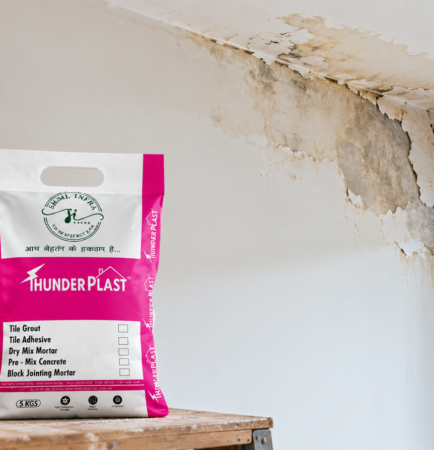
Plastering: Why “Curing-Free” and “Seepage-Free” Matter
Traditional plastering is labor-intensive and depends heavily on consistent curing — if curing is skipped or done poorly (which happens often on real sites due to time pressure), the plaster is left vulnerable to cracking and seepage later.
ThunderPlast Dry Mix Mortar (Ready Mix Plaster) is built for:
- Interior and exterior walls
- Repairs and joints
- Curing-free, seepage-free plastering
For contractors, this matters because it reduces dependency on perfect site conditions and curing schedules that are hard to guarantee in practice — and for homeowners, it means fewer cracks and seepage issues showing up months after the work is done.
Block Jointing: The Step Everyone Underestimates
Block jointing often gets treated as a minor step compared to plastering or concreting — but a weak joint between blocks is a weak point in the entire wall. Over time, poor jointing shows up as hairline cracks running along joint lines, especially in multi-story construction.
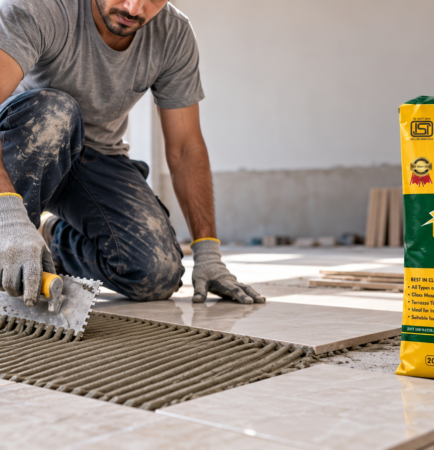
ThunderPlast Block-Jodo (Block Jointing Mortar) is built for fixing all types and sizes of blocks and bricks — giving masons a dedicated jointing material instead of relying on a generic mix for a job that needs consistency across hundreds of joints in a single wall.
Pre-Mix Concrete: Consistency Where It Counts
Concrete work for poles, hoardings, solar panel bases, driveways, and foundation filling demands consistency that’s hard to achieve with manual on-site mixing — batch-to-batch variation in a hand-mixed sand-cement-aggregate ratio is one of the most common (and preventable) causes of weak concrete.
ThunderPlast Hard Rock (Pre-Mix Concrete) is built for:
- Fixing poles, hoardings, and solar panels
- Making pavements, driveways, and filling foundations
- Repairs and joints
Because it’s pre-mixed, it removes a major variable from the equation — the guesswork of manual proportioning on site.
How These Three Work Together
Think of a typical wall-to-finish sequence on a mid-size construction site:
Block-Jodo joints the blocks → Dry Mix Mortar plasters the wall → Hard Rock handles foundation, pavement, or fixing work around the structure (poles, driveways) → and later, tiling and waterproofing products complete the finish.
Each stage depends on the one before it. A wall plastered beautifully over poorly jointed blocks is still a wall with a hidden weak point.
A Quick Reality Check for Contractors and Homeowners
- Plastering is not just about appearance — curing-free, seepage-free plaster reduces long-term maintenance.
- Block jointing quality directly affects crack resistance — it’s not a step to rush.
- Pre-mix concrete removes proportioning errors that are common with manual on-site mixing.
Final Word
The stages that happen before tiling and finishing — plastering, block jointing, and concreting — are where the real structural quality of a building is decided. ThunderPlast’s Dry Mix Mortar, Block-Jodo, and Hard Rock are built specifically for these stages, so contractors aren’t relying on generic mixes for jobs that need consistency and reliability.
Call us on our toll-free number 1800 889 5007 or visit www.thunderplast.com to know more about ThunderPlast’s plastering, block jointing, and concrete solutions.
FAQs
Q: What makes Ready Mix Plaster different from a traditional sand-cement plaster? ThunderPlast Dry Mix Mortar is built for curing-free, seepage-free plastering on interior and exterior walls, reducing dependency on perfect on-site curing conditions.
Q: Is Block-Jodo suitable for all block types? Block-Jodo is built for fixing all types and sizes of blocks and bricks.
Q: What is Hard Rock Pre-Mix Concrete used for? It’s used for fixing poles, hoardings, and solar panels, making pavements and driveways, filling foundations, and general repairs and joints.
Q: Why use pre-mix concrete instead of mixing on site? Pre-mix concrete removes the variability that comes with manual on-site proportioning, helping achieve more consistent results.